Everything’s possible
During the first semester of the third-year course in the Design and Development of Products Track in the Department of Mechanical Engineering, lecturer Naama Agassi initiated a unique cooperative project with the Fighters’ House in Be’er-Sheva. SCE students met with wounded and rehabilitating patients at the Fighters' House in Be’er-Sheva, learning about their daily challenges up close and, accordingly, developed novel products for their personal use, that would improve their independence and functioning. Each solution that was developed was, essentially, a practical expression of concern for their wellbeing, and of creativity, as well as of the power of engineering to change life.
Among the projects developed by the members of the course is a mechanical aid for tying shoelaces. Since his injury during the First Intifada, Kobi Segal has only had the full use of one hand. For the past 30 years, he has only worn laceless Blundstone boots, because he can’t tie shoelaces by himself. SCE students Adi Katar and Stav ‘Argi developed a small device for him that connects to the shoe and enables the required action to be performed with one hand. This small, smart product will enable him to tie the laces of his sports shoes for the first time in decades, so he may participate in sporting activities previously inaccessible to him.
Adi Timor, who was severely wounded in the recent war and lost a leg, was able to return to his hobby of kitesurfing after 10 months of rehabilitation. SCE students Yotam Gadish and Naftali Cohen designed a special sports prosthesis for him that enables him to surf. This smart prosthesis ensures that the leg remains stable and secured on the surfboard; nonetheless, if necessary, Adi can make a rotational movement with his leg and detach from the surfboard to return to the water, as any regular surfer might do. Since we’re already dealing with waves, Muhammad Fadila and Ibrahim Zir’ani, developed a compact device that helps when carrying a surfboard from the parking lot to the shoreline. This device can include a seat, so that someone who gets around in a wheelchair—like Eyal Sela, for whom this solution was designed—would be able to reach the waterline with surfing gear, even under conditions in which a regular wheelchair would be unsuitable.
Roni Gilgor, Dani Shtifman, and Walid Haleb also developed a smart device to help the wounded and rehabilitating by attaching to the shower wall by means of a vacuum, enabling them to perform actions like soaping, scrubbing, and drying the body in the shower with only one functioning hand. To this device, various other accessories may be attached by a stretchy tether, such as a towel, a sponge, or a louffa, and each accessory can be pulled away from the device with one hand and rebounds to its prior position on the device when released; this enables easy one-handed use even in areas difficult to reach, like the back.
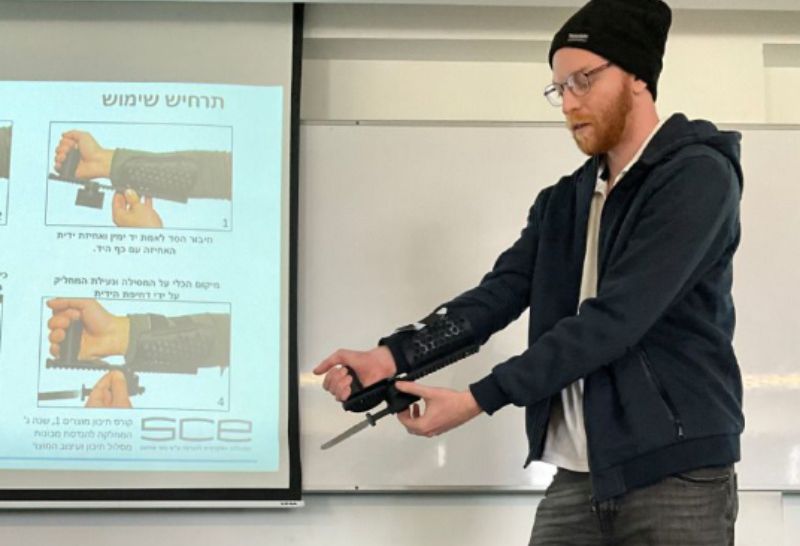
Ofek Sharvit and Rotem Rodrig created a device that opens jars, bottles and cans and is attached to the middle of a marble counter by means of a vacuum. On this device it is possible to place the container to be opened, where it is held by four silicon-coated teeth for maximal grip. Then, it is possible to open or close the container with one hand. Eddie Litvinov and Tomer Epstein also developed a device that attaches to the middle finger, to which a knife or some other tool may be attached, such that it is possible to cut and eat food independently, without relinquishing the use of two items of cutlery simultaneously.