


Eye Tracker
Eye tracking is the process of measuring the focal point and eye movements. In a dedicated laboratory room, potential users of interactive systems sit in front of a computer with an eye-tracker. The user-interface interaction is recorded by the eye-tracker’s software (Tobii Pro Lab), which captures the user’s eye movements and mouse movements. This tool enables a deep testing of the prototype design, with emphasize on identifying successful and unsuccessful interactions. For example, we can identify points of interest on the screen, or locate elements in the interface that users have difficulty understanding.
One advantage of this tool is that testing can also be conducted out in the field. There are certain situations where it is important to examine potential users in their “natural” environment.
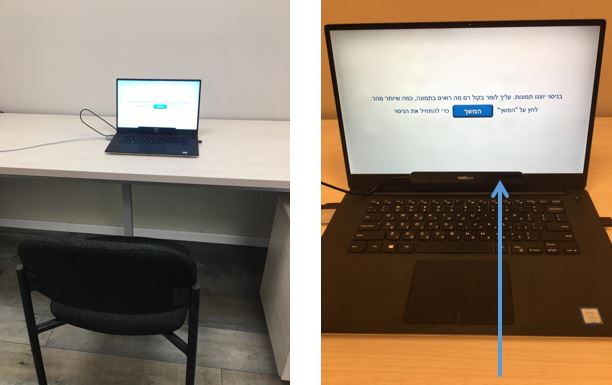
Instruments – An eye tracker attached to a laptop. The test itself is conducted in an acoustic room
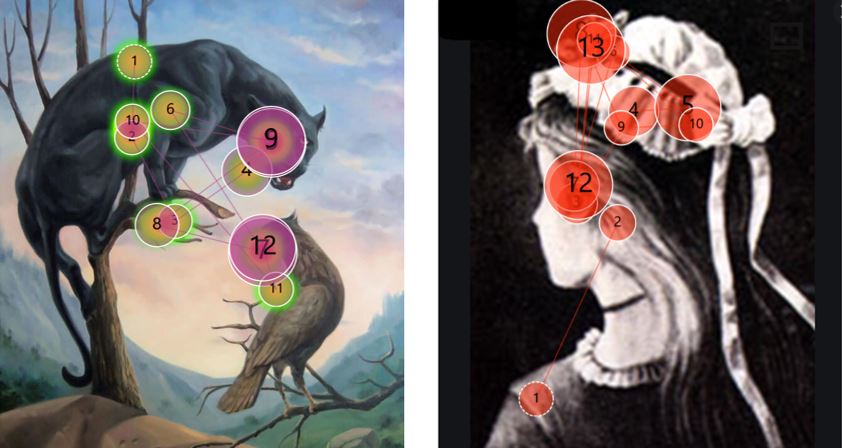
Images out of the “Ambiguous Images” experiment we conducted. The trial shows a congruence between the eye movements and
what the subject first sees. The right image is the young/old woman image, the left image is the woman’s face/jaguar and bird image
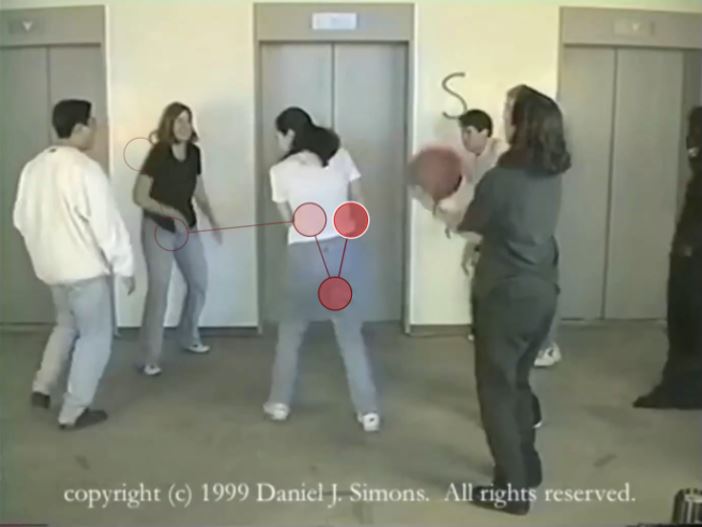
Images from the “Gorilla” attention experiment we conducted. The subjects were asked to count how many
times players wearing white shirts passed a ball between them. The experiment demonstrates why the subjects
do not see a person in a gorilla costume crossing the players’ path (appears in the right-most part of the image)
