Sometimes, a great change begins with a small roll of paper
For most of us, the use of toilet paper is automatic and only lasts for a few seconds; however, for people coping with upper-body physical disabilities, that simple action may become a complex task or require dependence on another person.
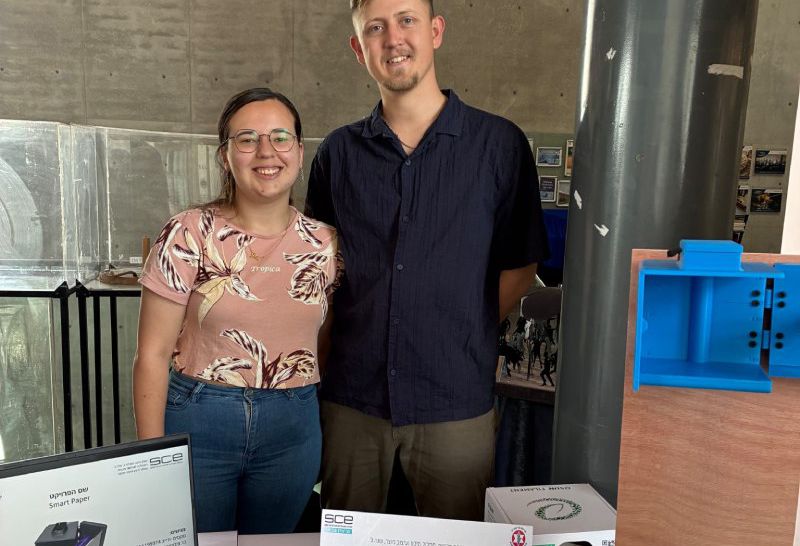
To resolve this daily problem, Bar Tsibutovski and Maxim Yudaev, third-year students of Mechanical Engineering at SCE, developed a system that enables the independent one-handed use of toilet paper. This development was made in conjunction with the international Tikun ‘Olam Makers (TOM) movement. It is intended for use by those with limited use of an upper limb.
Throughout the entire development process—from the stage characterizing the need and to the testing of the prototype—these two students worked under the guidance of their lecturer, Naama Agassi and designer Ilan Elkarat, together with Kobi Segal, a disabled I.D.F. veteran. The direct contact with Kobi and familiarity with his daily challenges enabled them to create a precise solution, suited to his needs.
This “Smart Paper” system was chosen as one of the outstanding projects at the annual Global Innovation Challenge (GIC) competition—TOM’s international innovation contest—in which hundreds of TOM community contestants from around the world compete. The “Smart Paper” project was recognized for its innovation, the quality of its engineering and the social value it creates.
The system is based on a movement sensor. When the user holds a hand underneath the device, toilet paper is automatically unwound, stopping at a predetermined point that enables the easy one-handed retrieval of the desired amount. At the Fighters’ House in Be’er-Sheva, people were impressed by this novel development and are currently working on the installation of such devices in all the washrooms, making it much easier for those coming for rehabilitation.
Naama Agassi, Coordinator of SCE’s “Product Planning and Design” track in the Department of Mechanical Engineering, says that SCE trains Engineers who do not merely develop technologies, but also the future—they are creative professionals, leaders to a better world. In her words: “It’s important to me that, during their studies, our students should experience a real process of product development for another person’s benefit. The understanding that I’m trying to inculcate is that Engineering is always for people, and indeed, they [SCE students] really do have the power to produce a positive influence on the lives of others.”
Dr. Nitzan Shauloff, Director of the TOM communities in the Negev region explains: “This project demonstrates the heart of TOM—the connection between people with real needs and the community of developers, engineers and students—who create influential solutions together. Seeing a solution that grew here in Israel and won international recognition is a great source of pride for us all.”
TOM—Tikun ‘Olam Makers is an NPO, an international organization for innovation, that connects people with disabilities and rehabilitation specialists with engineers, designers, students and volunteers, towards the goal of developing open-code technological solutions to real life challenges. By means of cooperative work with ‘those with special needs’, TOM enables the transformation of ideas into practical solutions that improve the quality-of-life of people around the world.